If your team still measures pallets by hand, you already know the hidden cost. It’s not just the minutes spent with a tape measure. It’s the bottlenecks at receiving and shipping. The inconsistent data. The rework. The disputes with carriers and customers. And the “we’ll fix it later” exceptions that turn into margin leaks. A pallet dimensioner helps you stop guessing.
A pallet dimensioner helps you automate the capture of length, width, height, weight, and images quickly and consistently—so your warehouse moves faster, bills more accurately, and can defend itself when claims and reclassifications arise.
This article breaks down the 7 biggest benefits of pallet dimensioning, plus what to consider before you implement one.
What Is a Pallet Dimensioner?
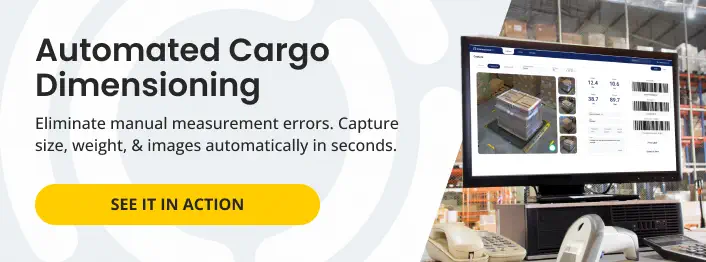
A pallet dimensioner (also called a pallet dimensioning system) automates the measurement process by capturing pallet dimensions and weight (and often HD images) as part of a standard workflow.
Instead of measuring by hand, writing numbers down, retyping them into a system, and manually taking photos, your team can place a pallet under the system and capture the data automatically. Most systems capture dimensions, weight, and images in seconds—making a major impact in high-volume operations (higher volume typically means higher ROI).
Why pallet measurements matter more than you think
In many operations, pallet measurements affect more than storage. They can directly impact:
- customer billing
- carrier invoices
- freight classification
- space planning
- receiving process
- and claim outcomes
For example, carriers often charge based on the greater of actual weight or dimensional (DIM) weight. So if the dimensions are wrong, the billed amount can be wrong too. And in LTL freight, dimensions and weight feed into density, which plays a big role in freight class and rating.
The common thread is simple: bad measurements create expensive conversations.
7 Benefits of a Pallet Dimensioner to Increase Warehouse Efficiency
1. Improve Warehouse Productivity at Receiving and Shipping
A warehouse associate can spend a surprising amount of time manually measuring pallet dimensions, weighing loads, and capturing images. And when pallets are irregular-shaped, the process often takes even longer. Over a full shift, that manual work adds up and slows the pace of receiving and shipping.
A pallet dimensioner makes this step faster and more consistent. Instead of measuring by hand and writing numbers down, the system can capture the pallet’s dimensions, weight, and images in seconds and enter it in the WMS. For warehouses that process hundreds or even thousands of pallets per day, reducing measuring time helps keep dock workflows moving and improves overall productivity.
This benefit is strongest when pallet dimensioning is treated as part of the normal dock process, not a “special station” used only when someone remembers. When it becomes a standard step, teams see fewer delays, fewer exceptions, and smoother flow through staging and outbound.
To learn more about how a pallet dimensioner works and its comparison with a manual process, watch this video:
2. Increase Measurement Accuracy
Manual pallet measuring often leads to inconsistent results and data. Two different associates can measure the same pallet and record slightly different numbers, especially when loads are uneven, wrapped loosely, or have overhang. And when the dock is busy, people tend to round measurements or rush the process just to keep freight moving.
The next issue is data entry. In many warehouses, measurements get written down first and then typed into a spreadsheet, TMS, WMS, or billing system later. Every time that data gets re-entered, the chance of a simple mistake goes up—transposed numbers, missing digits, or the wrong unit of measure.
A pallet dimensioner helps solve both problems. It accurately measures and captures dimensions and weight automatically and records them the same way every time. Because the data is collected digitally and entered in the WMS automatically, your team also reduces the need for manual typing and repeated entry. The result is cleaner measurement data you can trust for downstream processes like billing, audits, reporting, and freight planning.
Over time, this consistency makes operations smoother. Instead of debating whether the measurements are right, teams can focus on exceptions that truly need attention.
3. Support Legal-for-Trade Measurement Needs (NTEP)
If your warehouse charges customers based on measured dimensions and weight, you may need measurements that qualify as legal-for-trade. In the U.S., that often points to NTEP (National Type Evaluation Program) compliance.
NCWM (National Conference on Weights and Measures) issues an NTEP Certificate of Conformance after a device completes evaluation and is capable of meeting applicable requirements (including references to Handbook 44). This is why many warehouses and DCs look for NTEP-certified weights and measurements for certain commercial use cases.
Practical takeaway: Even if you’re not “selling by weight” in the classic sense, measurement credibility matters when invoices, audits, disputes, or contracts depend on those numbers.
You can check if a vendor is NTEP certified by searching the NTEP database. Here’s the link: NTEP Certificates of Conformance Database
4. Reduce Chargebacks and Protect Revenue Through Better Billing Data
Billing problems rarely show up as “measurement problems.” They show up as: customer disputes, carrier invoice adjustments, reclassification fees, and painful internal reconciliations. When you’re missing accurate dimensions and weights, two bad outcomes become common:
Outcome A – You under-bill: You charge less than you should because the system is using estimates, averages, or incomplete measurements.
Outcome B – You over-bill: Customers get billed too high, and then you issue credits, customer relationships get strained, and your team spends time on disputes instead of operations.
A pallet dimensioner improves revenue protection by tightening the data that billing depends on: more complete measurements, fewer exceptions, less “estimated” billing, and better defensibility. This is also where DIM weight matters. Since carriers often bill using the greater of actual or dimensional weight, measurement accuracy impacts cost calculations and pass-through billing.
5. Effectively Refute Claims from Customers and Carriers
Many pallet dimensioning workflows capture images during the measurement process, which gives you time-stamped visual proof of packaging condition, visible damage, pallet quality, labels, and how freight was staged at key handoff points. When claims happen, the difference between “we think it was fine” and “here’s what it looked like at inbound or outbound” is huge.
This benefit is especially strong for operations that deal with high-value items, fragile freight, frequent returns, or carrier handoffs where accountability is unclear.

6. Increase Profit by Lowering Labor Cost per Pallet
A pallet dimensioner can reduce labor cost in two ways:
I. Less time spent measuring and entering data: When you shorten the time required per pallet, you can handle the same volume with fewer labor hours, or increase throughput without adding headcount.
II. Less rework and fewer “exception tasks”: When measurements are inconsistent, you end up with rework, re-measuring, fixing shipments after the fact, reconciling billing, and managing disputes.
Those tasks are expensive because they pull experienced people away from core work.
Safety note: Manual measuring often encourages awkward moves—climbing, reaching, stretching, walking around loads in tight staging areas. Automating measurement reduces that exposure. (This doesn’t replace safe practices, but it can reduce risky repetition.)
7. Maximize Warehouse Space with Better Cubing and Slotting Decisions
In warehousing, space is money. However, many facilities still end up using space inefficiently because they don’t have reliable data to predict how much room each pallet truly needs. When dimensions are guessed or measured inconsistently, teams often over-allocate space “just to be safe,” or they place pallets wherever there’s room. Over time, that leads to underutilized locations, crowded aisles, and avoidable reshuffling.
A pallet dimensioner helps improve space utilization by capturing pallet dimensions, weight, and images quickly and accurately as freight comes in. With better data, your team can make smarter slotting and storage decisions right away. Instead of relying on assumptions, you can evaluate the best location for each pallet based on its actual size and handling needs, which improves storage efficiency and keeps the warehouse more organized.

What to validate before you implement
A dimensioner can be great—and still fail—if the workflow is wrong. Here’s what to validate early:
Workflow placement
- Receiving? Shipping? Both?
- Will forklifts naturally pass the measurement point?
- Is there enough space for safe staging and traffic flow?
Exception handling
- What happens when the pallet is overhang-heavy?
- What happens when the pallet is damaged?
- What happens when the measurement looks “off”?
Data flow
- Where does the data go?
- Who uses it?
- What fields are required for billing and operations?
Compliance needs
If you need legal-for-trade credibility, confirm the device’s certification and how you can verify it through official channels.
Support and uptime
Dock workflows depend on uptime. If the dimensioning process becomes part of the operation, support responsiveness matters—especially for multi-shift warehouses.
How Cyzerg typically fits into pallet dimensioning projects
If you want a worry-free approach, Cyzerg positions pallet dimensioning as part of a broader warehouse technology ecosystem, including:
- vendor-neutral recommendations,
- integration support,
- and 24/7/365 technical support depending on the solution and scope.
On the software side, Cyzerg also offers a dimensioning platform designed to centralize and standardize how dimensioning data is captured and managed, and it can be implemented with or without WMS integration depending on your needs.


Conclusion
A pallet dimensioner helps warehouses automate pallet measuring, weighing, and image capture in one consistent process. Instead of spending time measuring by hand and re-entering data, your team can collect accurate dimensions and weight faster and with fewer mistakes.
As a result, warehouses improve processing speed, accuracy, and overall efficiency at receiving and shipping. Over time, that also supports lower labor cost per pallet, better space utilization, stronger billing accuracy, improved profitability, and clearer documentation to help refute customer or carrier claims when disputes come up.
In addition to the benefits of a pallet dimensioner, check out the 6 things to validate before adopting a pallet dimensioner.
For more information about warehouse technologies and optimizing other warehouse processes, follow us on LinkedIn, YouTube, X, or Facebook. If you have other inquiries or suggestions, please contact us here. We’ll be happy to hear from you.
FAQs About Pallet Dimensioner
How accurate is a pallet dimensioner?
Accuracy depends on the model and setup, but pallet dimensioning systems are designed to measure pallets quickly and consistently. Some solutions specify accuracy ranges between ±0.25” and ±0.50”.
Do I need an NTEP-certified system?
If measurements are used for commercial transactions and you need legal-for-trade credibility, NTEP certification can be important. NCWM provides a database to search NTEP Certificates of Conformance.
Does dimensional weight matter for pallets, or only parcels?
Dimensional weight is commonly discussed for parcels, but the core idea—space vs. weight affecting cost—also shows up in freight pricing and density-based decisions. Carriers often charge based on DIM vs. actual weight (whichever is greater) for shipments where applicable.
How long does implementation take?
It depends on integration needs, physical setup, and workflow complexity, but on average, a typical implementation with Cyzerg and Supply Chain Orchestrator (Cyzerg’s software platform) takes no more than a few days from start to finish. If you start without heavy system integration, you can often deploy faster and then expand data flows over time.
What’s the fastest way to get ROI?
Use it consistently. The biggest ROI killer is “we bought it, but we don’t use it on every pallet.” Build the workflow, train the team, and track capture rate.