Many businesses look for ways to improve warehouse efficiency because it directly affects cost, service quality, and customer satisfaction. When operations slow down, the first reaction is often to add more labor just to keep up with demand.
However, adding people is not always the best answer. It increases operating costs, reduce profit margins, and create more chances for manual errors. In many cases, the better approach is to look at the process first.
Which steps take too long? Where do workers repeat the same tasks? Where does manual data entry slow the team down or create mistakes?
This is where warehouse technology can make a real difference. The right tools can help automate repetitive tasks, reduce unnecessary movement, improve data accuracy, and have better control over daily warehouse operations.
In this article, we’ll look at three warehouse technologies that can help improve warehouse efficiency: dimensioning systems, mobile technology, and a best-of-breed warehouse management system.
3 Technologies to Improve Warehouse Efficiency
Warehouse technology works best when it solves a clear operational problem. The right tools can reduce manual work, improve accuracy, and help teams move faster without adding unnecessary steps.
Here are three technologies that can improve warehouse efficiency across receiving, inventory handling, labeling, data entry, and process control.
1. Dimensioning Systems
Measuring pallets and boxes by hand can slow down the receiving process. In many warehouses, a receiving clerk may spend 40 to 55 seconds measuring cargo dimensions and entering the details into the WMS.
That may seem small for one pallet or parcel. However, the time adds up quickly when the receiving team handles a high volume of freight each day. Manual measurement also creates more chances for data entry errors, especially when workers need to move fast.
Dimensioning systems make this step easier. They automatically capture cargo measurements, so workers do not have to measure every pallet or parcel by hand. Once the system captures the dimensions, that data can be added to the system automatically and accurately.
Some dimensioning systems also integrate with weighing scales. This allows the warehouse to capture both dimensions and weight in one step. Others can take high-definition images of the cargo, which gives the team a clearer record of what was received and its condition.
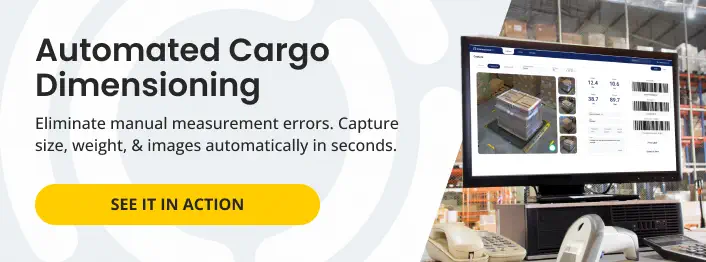
The time savings can be significant. By automating the measurement process, warehouses can reduce the time spent measuring boxes and pallets by at least 68%.
This also helps reduce manual data collection errors. When the dimensioning system integrates with the WMS, teams get more accurate cargo data, better shipment records, and a faster way to complete one of the most repetitive steps in receiving.

2. Mobile Technology
Mobile technology helps warehouse teams work from where the task is happening, instead of returning to a fixed workstation for every update.
This matters because warehouse employees are constantly moving. They receive inventory, put items away, pick orders, pack shipments, and load outbound freight. When they have to walk back and forth to access the WMS, print labels, or enter data, small delays can build up across the entire day.
Mobile tools reduce that wasted movement. They help workers scan items, update records, print labels, and complete tasks directly from the warehouse floor.
a. Mobile Computers
Mobile computers give warehouse employees access to systems and information while they work. These devices can include rugged tablets, handheld computers, or other mobile terminals designed for warehouse environments.
Unlike standard consumer devices, warehouse-grade mobile computers are built for rougher conditions. They usually offer stronger durability, longer battery life, better scanning options, and reliable wireless connectivity.
With the right device, workers can complete tasks faster because they do not have to rely on paper forms or fixed workstations. They can scan inventory, confirm tasks, update locations, and send information to the WMS in real time.
b. Mobile Printers
Mobile printers are another useful tool for warehouse teams. Instead of walking to a central printing station, workers can print labels where the work is happening. For example, a receiving clerk can print pallet labels at the dock. A shipping team can print labels near the loading area. A worker handling inventory moves can print labels from the aisle or staging location.
This helps reduce walking time, prevent label mix-ups, and keep work moving. However, mobile printers depend on strong wireless coverage. If the warehouse network is unreliable, printing delays can still happen.
c. Wearable Mobile Computers & Barcode Scanners
Wearable mobile computers and barcode scanners help workers keep their hands free while completing tasks. This is especially useful in fast-moving warehouse processes such as receiving, put-away, picking, packing, sorting, and shipping.
Instead of carrying a handheld device all day, workers can use wearable scanners to capture barcode data quickly while handling products. This can make repetitive scanning tasks faster and more comfortable.
These tools also help improve accuracy. When workers scan items as they move through each process, the WMS receives better real-time data about inventory movement, task completion, and shipment status.
3. Best-of-Breed WMS
Warehouse technologies only create value when they can work with the systems that run the operation. That is why a best-of-breed warehouse management system, or WMS, is so important.
A WMS helps manage inventory, tasks, workflows, and provide clear visibility into daily operations. Equally importantly, it gives the warehouse a central system that can integrate with other tools, such as mobile devices, scanners, printers, scales, and dimensioning systems.
However, not every WMS is built for modern warehouse technology. To support efficiency, the system needs to be mobile-friendly, easy to integrate, and built around real warehouse workflows.
a. Mobile Friendly
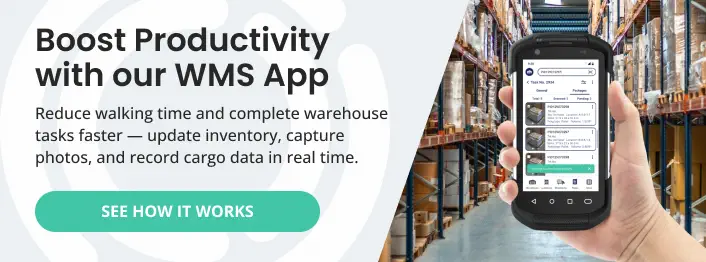
A mobile-friendly WMS allows workers to access the system from the warehouse floor. This can be through a native mobile app or a responsive web app that works well on mobile devices.
This matters because warehouse work does not happen behind a desk. Workers need to receive items, scan inventory, confirm picks, update locations, and complete tasks while moving through the facility.
When the WMS works well on mobile devices, teams can enter and access information closer to the work. As a result, they can reduce paper use, avoid extra trips, and update records faster which provides real-time information flow.

b. Easy, Low-Cost Integration
A strong WMS should also connect easily with other warehouse technologies. If the system is difficult or expensive to integrate, it can limit what the warehouse can automate.
Look for a WMS with reliable API integration. This makes it easier to connect the system with mobile devices, barcode scanners, dimensioning systems, accounting software, ERPs, ecommerce platforms, and other business tools.
Integration matters because warehouse data needs to move across systems without constant manual entry. When systems work together, teams can reduce duplicate work, improve accuracy, and make faster decisions.
c. Workflow & Process Oriented
The best WMS platforms do more than store inventory records. They help guide warehouse processes from start to finish.
A workflow-oriented WMS can help define how tasks should be completed, who should complete them, and what steps need to happen next. This is useful for receiving, put-away, picking, packing, shipping, cycle counting, and other daily warehouse activities.
It also helps managers see how work is moving through the operation. With better visibility, they can spot delays, measure productivity, and make process improvements based on real warehouse activity.
When a WMS supports mobile work, integration, and workflows for process control, it becomes more than a system of record. It becomes a tool that helps improve warehouse efficiency across the entire operation.

Source: Supply Chain Digest
How to Choose the Right Technology to Improve Warehouse Efficiency
One of the most common warehouse management mistakes is buying technology before identifying the actual bottleneck.
Start by looking at the process that slows the team down the most.
If receiving takes too long because workers manually measure pallets and boxes, a dimensioning system may be the best starting point. It can speed up data capture, reduce manual entry, and help the team build more accurate records.
If workers lose time walking back to fixed workstations, mobile technology may offer the quickest improvement. Mobile computers, printers, and scanners help employees complete tasks from the floor, where the work is actually happening.
However, if the warehouse lacks process control, system visibility, or reliable data flow, the WMS may need attention first. A stronger WMS can connect tools, guide workflows, and give the team a clearer view of inventory and task activity.
The key is to avoid buying technology just because it looks useful. First, identify the problem. Then choose the tool that helps solve it with the least disruption to daily operations.


How to Measure If Warehouse Technology Is Improving Efficiency
Warehouse technology should improve more than one task. It should create measurable gains in speed, accuracy, labor use, or process control.
Start with the problem the technology was meant to solve. Then compare performance before and after implementation.
For example, if you added a dimensioning system, track receiving time, measurement accuracy, and data entry errors. If you added mobile devices, look at walking time, task completion speed, scan accuracy, and label reprints. If you upgraded the WMS, measure order cycle time, inventory accuracy, picking accuracy, and on-time shipping.
The goal is not to track every warehouse metric at once. Instead, focus on the KPIs connected to the process you want to improve.
A few useful metrics include receiving time, labor productivity, order cycle time, inventory accuracy, picking accuracy, and shipping performance. These numbers help show whether the technology is actually making work easier, faster, and more consistent.
Over time, the data can also show where the next improvement should happen. That way, technology decisions stay tied to real warehouse performance instead of guesswork.
Conclusion
The right warehouse technology can help businesses improve warehouse efficiency by reducing manual work, improving accuracy, and helping teams keep up with increasing operational demands.
Dimensioning systems can speed up receiving and improve cargo data capture. Mobile technology can help workers complete tasks from the warehouse floor. Meanwhile, a best-of-breed WMS can connect tools, guide workflows, and give teams better visibility across the operation.
The right technology does more than make one task faster. It helps create a more efficient warehouse process from receiving to shipping.
By choosing tools that match the warehouse’s biggest challenges, businesses can protect margins, improve daily performance, and stay more competitive in a demanding logistics environment.
If you want to learn more about warehouse digitalization and optimizing warehouse processes, you can follow us on LinkedIn, and on YouTube. If you have other inquiries or suggestions, please contact us here. We’ll be happy to hear from you.
FAQs
1. What technologies can help improve warehouse efficiency?
Dimensioning systems, mobile technology, and a best-of-breed WMS can help improve warehouse efficiency. They reduce manual work, improve data accuracy, speed up warehouse tasks, and give teams better control over daily operations.
2. How does mobile technology improve warehouse operations?
Mobile technology helps workers scan items, update records, and print labels from the warehouse floor. This reduces walking time, speeds up tasks, and helps keep inventory data more accurate.
3. Why are dimensioning systems useful in a warehouse?
Dimensioning systems automatically measure pallets and parcels. They help receiving teams capture dimensions, weight, and digital images faster while reducing manual entry errors.
4. Why is a WMS important for warehouse efficiency?
A WMS helps manage and organize inventory, tasks, workflows, and warehouse data. It also connects tools like scanners, printers, scales, and dimensioning systems so teams can work with better visibility and fewer manual steps.
5. How should a warehouse choose the right technology?
A warehouse should choose technology based on its biggest bottleneck. Slow receiving may need dimensioning systems, excessive walking may need mobile tools, and poor visibility may require a stronger WMS.